
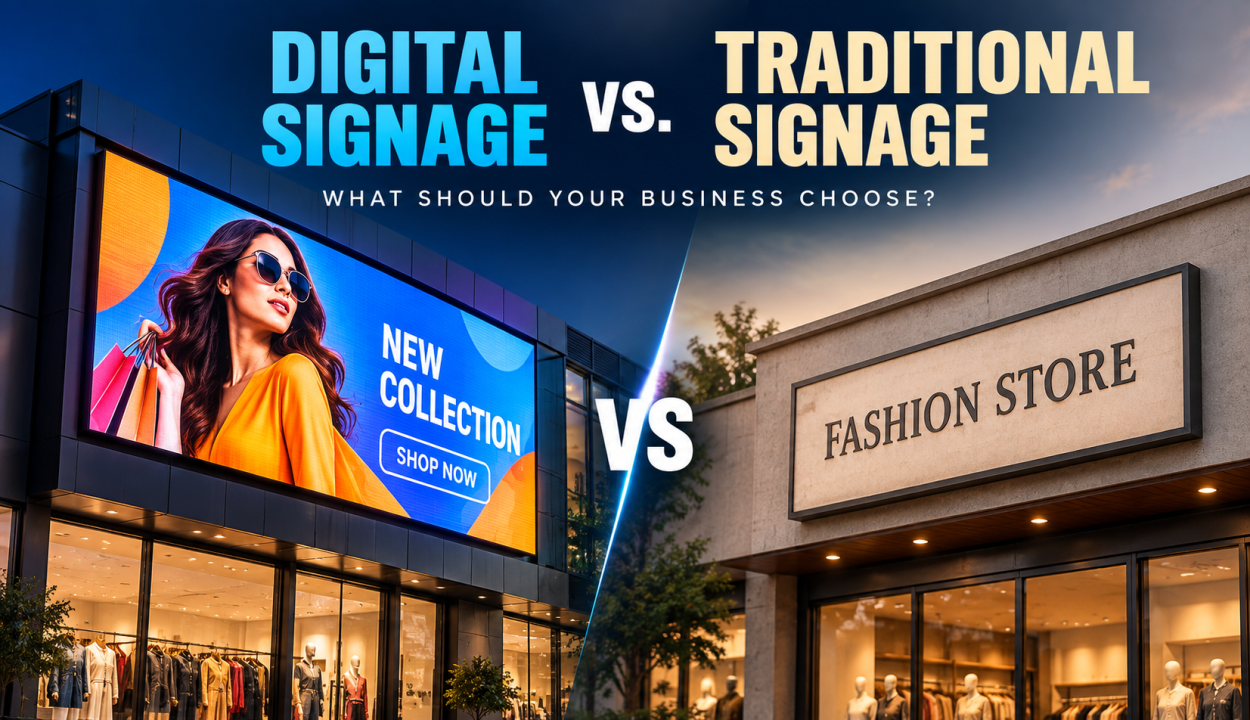
A sign does more than display your business name; it communicates, attracts attention, and shapes how people experience your space.
But when it comes to choosing between digital signage and traditional signage, newer doesn’t always mean better.
The right choice depends on what you need your signage to achieve, how often your message changes, where it will be installed, and who needs to see it.
So, which one makes more sense for your business? Let’s break it down.
What Is Traditional Signage?
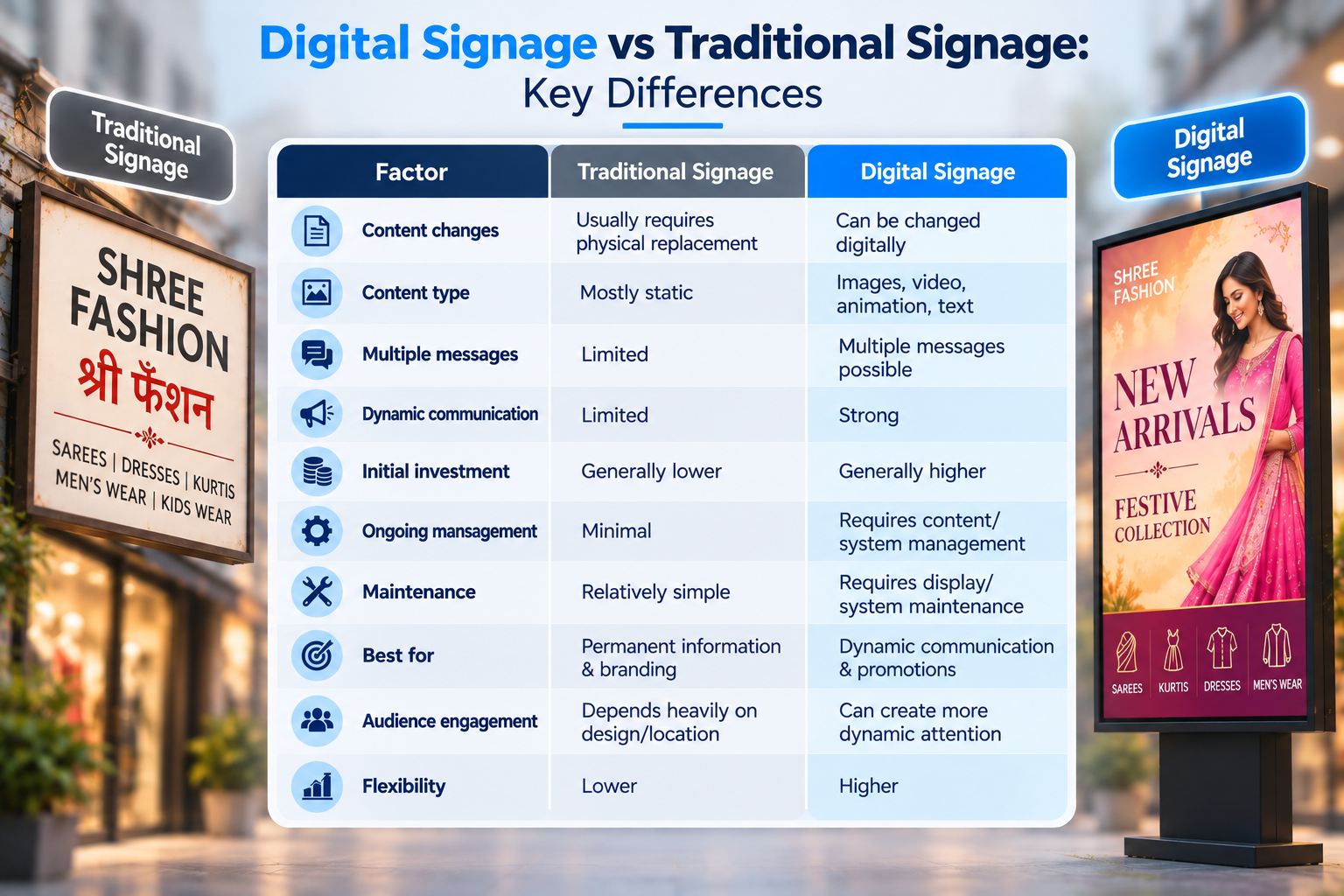
Traditional signage refers to static signs that display fixed information, branding, or directions. These can include name boards, printed signs, acrylic signs, 3D letters, and illuminated boards.
What Is Digital Signage?
Digital signage uses electronic displays to show content such as images, videos, text, and announcements. The content can be updated or changed digitally without replacing the physical sign.
Which One Is Better for Your Business?
There’s no one-size-fits-all answer. The right signage depends on what you need it to do.
Choose Traditional Signage If:
- Your message is fixed and long-term
- You mainly need brand identification or directions
- Your content rarely changes
- You want a simple, low-maintenance solution
Choose Digital Signage If:
- Your content needs to change regularly
- You want to display videos, offers, announcements, or multiple messages
- You need more flexibility in what you communicate
- You want your signage to create a more dynamic customer experience
Or Choose Both
Sometimes, the smartest solution isn’t choosing one over the other.
Traditional signage can support permanent branding, while digital displays can support changing messaging.
The goal isn’t to choose the most advanced option. It’s to choose the signage that makes the most sense for your space, audience, and business needs.
Consider These 6 Factors Before You Decide
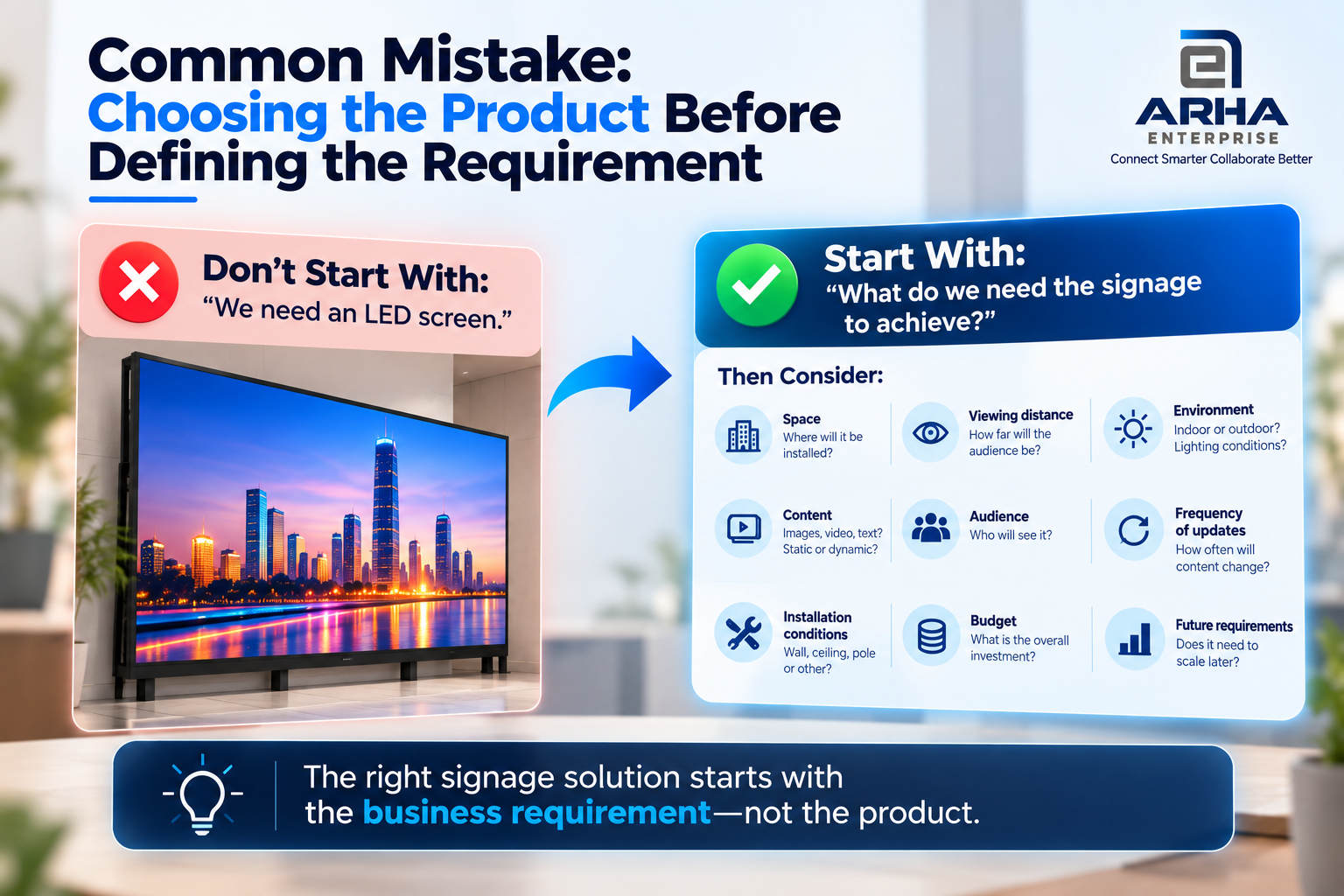
Choosing between digital and traditional signage shouldn’t start with “Which one looks better?” It should start with “What does my business actually need?” Before investing in a signage solution, consider these six factors:
1. What Is the Purpose of the Signage?
Start with the job your signage needs to do. Is it meant to identify your business, attract attention, provide directions, promote offers, share information, or improve the customer experience? A permanent brand name board may not need a digital display. But if you want to showcase changing promotions or content, digital signage may offer more flexibility.
2. How Often Will Your Content Change?
Consider how often you’ll need to update your message.If your signage will display the same information for months or years, traditional signage can be a practical choice. If you regularly change offers, announcements, products, menus, or promotional content, digital signage can make those updates much easier.
3. Where Will the Signage Be Installed?
The location can significantly influence the right solution. Consider:
- Indoor or outdoor installation
- Viewing distance
- Available space
- Ambient lighting
- Footfall and traffic
- Viewing angles
A display designed for an indoor reception area, for example, may have very different requirements from an outdoor screen visible from a busy road.
4. Who Needs to See It?
Your audience matters.
A retail store may need signage that quickly catches a shopper’s attention. A hospital may need clear information and way finding. A corporate office may need visitor information, announcements, or branding.
The audience and their environment should influence the signage—not just the technology.
5. What Is Your Total Budget?
Don’t look only at the initial purchase price. Consider the total cost of ownership, including:
- Equipment or materials
- Installation
- Power requirements
- Content management
- Maintenance
- Repairs
- Future upgrades
A lower upfront cost doesn’t always mean a lower long-term cost, and a higher initial investment can make sense when the signage delivers greater flexibility or business value.
6. How Much Flexibility Will You Need?
Think beyond today’s requirement. Will your content, promotions, products, or communication needs change over time?
If yes, a flexible digital solution may provide more long-term value. If your requirement is permanent and straightforward, traditional signage may be all you need.
The right signage is not about choosing the latest technology. It’s about choosing the right technology for your requirement. Understand the purpose, space, audience, content, budget, and future needs first. Then decide whether traditional signage, digital signage, or a combination of both makes the most sense.
How Arha Helps You Choose the Right Signage Solution
Choosing the right signage isn’t just about selecting a display or a signboard. It starts with understanding what your business actually needs.
At Arha, we follow a simple approach:
- Understand the Requirement: We look at your business objective, space, audience, viewing conditions, content requirements, and budget before recommending a solution.
- Recommend the Right Technology: Based on the requirements, we help you determine whether traditional signage, digital signage, LED displays, commercial displays, or a combination is the right fit.
- Plan for the Space: The right technology still needs to work in the right environment. Factors such as screen size, viewing distance, brightness, placement, and installation conditions are considered before implementation.
- Execute the Solution: Once the solution is decided, Arha supports the implementation to ensure the technology is properly installed and works as intended.
Because the goal isn’t to sell you a screen. It’s to give your business a signage solution that makes sense.
Final Verdict: Digital or Traditional?
So, which one should your business choose? There’s no universal winner—and that’s the point.
Choose traditional signage when you need permanent branding, simple information, or a low-maintenance solution.
Choose digital signage when you need changing content, promotions, videos, announcements, or more flexibility.
And if your business needs both, a combination of traditional and digital signage may be the smartest choice.
Ultimately, the best signage isn’t the biggest screen or the newest technology. It’s the solution that fits your space, serves your audience, and solves your business requirement.